Unfortunately, although the timeline and presentation is complete and printed, I have left my digital copies on my hard-drive, a hard-drive I have left at university. As a result of this, the final timeline and presentation cannot be uploaded until tomorrow afternoon.
As an additional issue spawned from this forgetfulness I have been unable to write speaker notes for the presentation The best I can do now is know my own research inside and out and hopefully, present it well enough for the grade I wish to achieve.
NEXT POST: VIOLENCE IN GAMES: FINAL TIMELINE AND PRESENTATION
Showing posts with label Timeline. Show all posts
Showing posts with label Timeline. Show all posts
Tuesday, 16 April 2013

VIOLENCE IN GAMES: CHILLER OF THE ARCADE (1986)
The premise?
"Find ways to kill them victims quicker..."
"Find ways to kill them victims quicker..."
This quote sums up Chiller of The Arcade, released in 1986, instantly. Released originally in the arcade, then swiftly moving over to the NES, Chiller of the Arcade took the player through various classic horror film settings, letting players take control of the avatar - the murderer. The aim of the game game is simple, in each stage, find a way to kill the "helpless victims" using torture devices - again, a game focused entirely around murder with extreme violence. The image below gives a great impression of the game play.
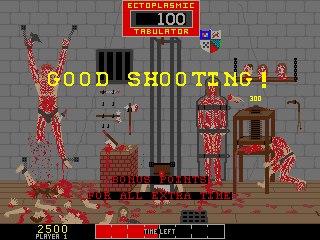 |
| CHILLER OF THE ARCADE - DUNGEON VIOLENCE GAMEPLAY |
Players earn points through finding creative ways to murder these helpless victims as quick as possible. Every action you take mutilates the victims in a clearly graphic and needless way. As discussed in previous posts, culture isn't kind to games that mindlessly use violence for progression and entertainment - Chiller of the Arcade does, much like Carmageddon and Manhunt 1 'and' 2.
For the time, Chiller of the Arcade had realistic graphics, it made use of its pixels completely allowing the game to represent violence and proportion as realistically as Carmageddon, only on a 2D. The issue, at this time, was that games were not rated 18, this would only come into play in the fifth generation. Because of this, many kids had a copy of this game and in result, controversy spared, with a quote stating "this games promotes he murder of innocent people, not enemies that can defend them self . And in that sense I agree, just as I do with the other mindlessly violent games I have researched.
To me, along with Andrews research on games like Manhunt and Grand Theft Auto, this solidifies our conclusion, and will form the basis of the timeline and presentation. Along with the angle I have highlighted, Andrew has also revealed some interesting aspects of violence in games. Aspects such as "Can violence be used to evoke emotions and drive story?" or "Do games influence gamers to commit crime?". With all of these angles, I personally believe both I and Andrew have conducted a thorough and conclusive research portfolio covering violence in games - we explored every angle we though necessary.
NEXT POST: ISSUES WITH WORK UPLOADING
VIOLENCE IN GAMES: SOLDIER OF FORTUNE (2000)
In the majority of the research I have carried out, violence in games was always existent because of three things, entertainment, culture, and conflict. As I move into modern times with modern digital games and violence, there has been a clear shift in how and why this violence is used along with how it is consumed and perceived - the clear culprit is evolution of culture. Carmageddon showed this with mindless violence for the sake of violence, and Manhunt (as seen in Andrew's blog) seemed to take weird pride in disturbing murders that the players committed - both of which caused serious controversies. This next game, Soldier of Fortune, didn't cause a controversy, but caused many heads to turn at the level of violence you could commit.
 |
| SOLDIER OF FORTUNE (2000) - CONTEXT SENSITIVE VIOLENCE |
Soldier of Fortune, originally released in 2000 on PC, is a first person shooter that pushes mutilation and context sensitive damage as a USP using the "GHOUL Damage Model engine developed by Raven Software" that "enabled the depiction of extreme graphic violence" - the developers and publishers of Soldier of Fortune 1 and 2. Although praised for it's character and entertaining game play and damage mechanics, in 2000 after it's release, the controversy began - Soldier of Fortune was rated specifically an "Adult Motion Picture", in other words, it was labelled as "Pornography".
It sounds crazy, but the level of detail the engine facilitated was unheard of before this release. Players could take a knife, and literally cut away into the corpses, revealing more and more organs. This completely optionally mechanic served no real purpose, arming players with a knife for the sole purpose of causing bodily mutilation This extreme take on violence, although entertaining on the most part, was clearly controversial, but it's important to note that it is completely optional. Players could turn the violence off, revealing the solid first person game play experience that it was praised for.
In a sense, Soldier of Fortune is a coin of two sides. One one side, you have a violent game that really has no need for it, where as on the other side, you have a great first person shooter with a solid story, that has no violence or at least optional. So it seems violence isn't 'always' a terrible thing, but became of this games positives, it highlights the issues of violence in video games with a a bright light - mindless violence is what causes the controversy, not violence itself. Maybe it gives off a bad message? That's not to say it makes people commit murder.
Personally, I played the game and loved it when it was released, but I was shocked by the violence and have never looked at games the same way again. In fact, when I first played it, I was disturbed when I first shot an enemy with a shotgun and saw the limbs detach, revealing bones and organs. Yes, it gave the game it's character, and yes, I will always remember it for the violence, but I don't believe the violence was used in a despicable manner like Carmageddon or Manhunt did. It's all about how you use it in a stern modern society. Again, it is society that is the factor, after all, it is just a game, one of which was rated for adults, not children - parents chose to buy it for them.
This game isn't the most well known violent game in the short history of video games, but to me, it's been the most important as of yet, as it's positives highlight the negatives and causes for controversy for not just this game, but for all the previous games I have researched. I guess this is the research almost done when you consider the work Andrew has done. We have highlighted a pattern, researched the deeper factors behind it, and pinpointed the causes. Now all that is left, is to solidify these conclusions and complete the timeline and presentation to exhibit our findings.
NEXT POST: VIOLENCE IN GAMES: CHILLER OF THE ARCADE (1986)
It sounds crazy, but the level of detail the engine facilitated was unheard of before this release. Players could take a knife, and literally cut away into the corpses, revealing more and more organs. This completely optionally mechanic served no real purpose, arming players with a knife for the sole purpose of causing bodily mutilation This extreme take on violence, although entertaining on the most part, was clearly controversial, but it's important to note that it is completely optional. Players could turn the violence off, revealing the solid first person game play experience that it was praised for.
In a sense, Soldier of Fortune is a coin of two sides. One one side, you have a violent game that really has no need for it, where as on the other side, you have a great first person shooter with a solid story, that has no violence or at least optional. So it seems violence isn't 'always' a terrible thing, but became of this games positives, it highlights the issues of violence in video games with a a bright light - mindless violence is what causes the controversy, not violence itself. Maybe it gives off a bad message? That's not to say it makes people commit murder.
Personally, I played the game and loved it when it was released, but I was shocked by the violence and have never looked at games the same way again. In fact, when I first played it, I was disturbed when I first shot an enemy with a shotgun and saw the limbs detach, revealing bones and organs. Yes, it gave the game it's character, and yes, I will always remember it for the violence, but I don't believe the violence was used in a despicable manner like Carmageddon or Manhunt did. It's all about how you use it in a stern modern society. Again, it is society that is the factor, after all, it is just a game, one of which was rated for adults, not children - parents chose to buy it for them.
This game isn't the most well known violent game in the short history of video games, but to me, it's been the most important as of yet, as it's positives highlight the negatives and causes for controversy for not just this game, but for all the previous games I have researched. I guess this is the research almost done when you consider the work Andrew has done. We have highlighted a pattern, researched the deeper factors behind it, and pinpointed the causes. Now all that is left, is to solidify these conclusions and complete the timeline and presentation to exhibit our findings.
NEXT POST: VIOLENCE IN GAMES: CHILLER OF THE ARCADE (1986)
VIOLENCE IN GAMES: CARMAGEDDON (1997)
When the fifth generation of gaming consoles hit the market, the 1994 console release Playstation 1 promised better graphics, better game play and far greater immersion. In most cases, the Playstation proved successful, but it was soon apparent that this creative freedom could be utilized for something different that had never been done before - realistic violence.
I personally remember opening up a gaming magazine to read in depth about SCI's new IP, Carmageddon - what Mail Online calls;
It seemed fun and fresh, but at such a young age, it actually disturbed me, because Camageddon's concept and game play revolved entirely around one thing - murder by reckless driving. Instantly this gives off all kinds of wrong messages to children, and considering it was my first look at violence in anything, It's safe to say it had a negative impact on me.
Here's the premise - players race against other opponents whilst battling against a timer. The only way to beat the timer, is to run over pedestrians violently to earn time bonuses. The ability to commit such mindless violent acts is no surprise when you consider the Vikings and various other cultures did the exact same thing ages ago, but regardless, controversy stuck hard considering the new platform and potentially exposed audience.
In a culture where murder is illegal, the death penalty is banished and pretty much any negative action is looked down upon, Armageddon was an in your face reminder that this type of violence isn't welcome anymore (unlike in the Roman rule). Along with this dismissal and controversy over this extremely graphic virtual violence, the platform posed issues also - children could join in on the violence (virtual violence of course). But considering I was effected greatly by it (I cried), it's easy to see how such easy exposure to violence is controversial, raising many questions as to where and what games should be and go. In fact, this game was so violent for the time, it was the first game to be refused an ERSB rating - it was too violent.
Carmageddon was one of the first real controversies in gaming, as this experience was a more immersive than it's arcade counterparts such as Death Race (similar concept), as they were just concepts backed by 8-bit graphics, Carmageddon was a concept executed through fully 3D models of violence - violence which dominated the entire screen and game. It was seen as 'entertainment' to commit such blind acts of virtual violence. It not only spread the message that violence was entertaining and rewarding, but it glorified it and promoted reckless driving to potential innocent children. The latter point is the key point in this controversy, and still is today.
SCI eventually re-cut the game, replacing "pedestrians with zombies" to justify the violence, but in an open statement, SCI admitted that "the violence and controversy was deliberately courted" - this says it all really.
Now, there are many sides to this argument that exist even today. But Camrageddon was admittedly one of those games that went to far too soon. What I find interesting about this game however, is it's sheer contrast (and similarities) to the previous research I have carried out. Carmageddon was a game that used violence for no other reason than to have violence. And when children could be exposed to such things and a culture that is radically different that for example, the Roman Empire, you have a game that allowed people to commit acts of violence with no punishment, only reward. This is the difference between then and now. Back in ancient times, violence may have been more common in society as a whole, but when used for entertainment, it was mostly controlled, usually backed by cultural praxis or military conflict. Here, it's mindless and dangerous.
From this point, if you take a look at Andrew's blog, you will see that this pattern in a revised modern society continue to make itself known, bringing along many controversial stories along with it. Games such as Manhunt and Grand Theft Auto stimulate the same arguments from different angles, and I think this is entirely down to the platform, modern society, and the use of violence in this accessible media.
It's surprising to say, that even with this controversy that still makes itself known today, Camrageddon is actually being remade as a result of a die hard community kickstarter, again, spawning further controversy. Carmageddon was a lesson to all developers when it came to violence in games, but violence in games has never held back, the way it is used however, has changed.
NEXT POST: VIOLENCE IN GAMES: SOLIDER OF FORTUNE (2000)
 |
| CARMAGEDDON - VIOLENT GAMEPLAY |
I personally remember opening up a gaming magazine to read in depth about SCI's new IP, Carmageddon - what Mail Online calls;
"The most controversial game of all time".
Here's the premise - players race against other opponents whilst battling against a timer. The only way to beat the timer, is to run over pedestrians violently to earn time bonuses. The ability to commit such mindless violent acts is no surprise when you consider the Vikings and various other cultures did the exact same thing ages ago, but regardless, controversy stuck hard considering the new platform and potentially exposed audience.
In a culture where murder is illegal, the death penalty is banished and pretty much any negative action is looked down upon, Armageddon was an in your face reminder that this type of violence isn't welcome anymore (unlike in the Roman rule). Along with this dismissal and controversy over this extremely graphic virtual violence, the platform posed issues also - children could join in on the violence (virtual violence of course). But considering I was effected greatly by it (I cried), it's easy to see how such easy exposure to violence is controversial, raising many questions as to where and what games should be and go. In fact, this game was so violent for the time, it was the first game to be refused an ERSB rating - it was too violent.
Carmageddon was one of the first real controversies in gaming, as this experience was a more immersive than it's arcade counterparts such as Death Race (similar concept), as they were just concepts backed by 8-bit graphics, Carmageddon was a concept executed through fully 3D models of violence - violence which dominated the entire screen and game. It was seen as 'entertainment' to commit such blind acts of virtual violence. It not only spread the message that violence was entertaining and rewarding, but it glorified it and promoted reckless driving to potential innocent children. The latter point is the key point in this controversy, and still is today.
SCI eventually re-cut the game, replacing "pedestrians with zombies" to justify the violence, but in an open statement, SCI admitted that "the violence and controversy was deliberately courted" - this says it all really.
Now, there are many sides to this argument that exist even today. But Camrageddon was admittedly one of those games that went to far too soon. What I find interesting about this game however, is it's sheer contrast (and similarities) to the previous research I have carried out. Carmageddon was a game that used violence for no other reason than to have violence. And when children could be exposed to such things and a culture that is radically different that for example, the Roman Empire, you have a game that allowed people to commit acts of violence with no punishment, only reward. This is the difference between then and now. Back in ancient times, violence may have been more common in society as a whole, but when used for entertainment, it was mostly controlled, usually backed by cultural praxis or military conflict. Here, it's mindless and dangerous.
From this point, if you take a look at Andrew's blog, you will see that this pattern in a revised modern society continue to make itself known, bringing along many controversial stories along with it. Games such as Manhunt and Grand Theft Auto stimulate the same arguments from different angles, and I think this is entirely down to the platform, modern society, and the use of violence in this accessible media.
It's surprising to say, that even with this controversy that still makes itself known today, Camrageddon is actually being remade as a result of a die hard community kickstarter, again, spawning further controversy. Carmageddon was a lesson to all developers when it came to violence in games, but violence in games has never held back, the way it is used however, has changed.
NEXT POST: VIOLENCE IN GAMES: SOLIDER OF FORTUNE (2000)
Sunday, 14 April 2013
VIOLENCE IN GAMES: TIMELINE TEMPLATE
After completing the majority of my research (the rest to be carried out tomorrow), highlighting patterns and key aspects of violence in games, I decided to make a start on the timeline that will work in co-operation with the presentation that both me and Andrew are to give on Wednesday the 17th of April.
The original idea was to present the timeline adopting a 'crime board' theme, as discussed in a previous post of mine. However, whilst attempting to develop that idea on Photoshop, it seemed boring - I guess it sounded better on paper. So I decided to scrap that idea on the most part and blend it with another visual style. Some aspects still remain, such as the pins, the notes and pretty much the whole practical theme, but I blended it with a nice digital layout that I think looks much better.
The original idea was to present the timeline adopting a 'crime board' theme, as discussed in a previous post of mine. However, whilst attempting to develop that idea on Photoshop, it seemed boring - I guess it sounded better on paper. So I decided to scrap that idea on the most part and blend it with another visual style. Some aspects still remain, such as the pins, the notes and pretty much the whole practical theme, but I blended it with a nice digital layout that I think looks much better.
It doesn't look too flashy small, so open the image in another tab to see it at it's nearly full quality!
 |
| VIOLENCE IN GAMES: TIMELINE TEMPLATE by Christian Whelan |
I must note, that this is just a template, ready to have the information thrown in there - it is not a finished idea. The idea is to have the concept above, with a little more information in there, and I mean a little. Such information types such as quotes and buzzwords will be added in where necessary, to make the timeline a little more readable, a at the moment, it's just pictures and dates, which is a timeline for sure, but not a very interesting one.
Although a low resolution when you look at it, the timeline is actually A4 in height and 5 times A4 in width, so it's quiet a lengthy timeline. I may need more space, but me and Andrew will try our best to compile all the information onto this template.
Although a low resolution when you look at it, the timeline is actually A4 in height and 5 times A4 in width, so it's quiet a lengthy timeline. I may need more space, but me and Andrew will try our best to compile all the information onto this template.
Anyway, I think Andrew will like it, so once I get approval, we'll compile the research, put it into the timeline, and by tomorrow night, it should be finished along with the research and coupling presentation.
NEXT POST: VIOLENCE IN GAMES: CARMAGEDDON (1997)
Saturday, 13 April 2013
VIOLENCE IN GAMES: IGN VIOLENCE ARTICLES
Even when not researching for this project, I'm coming across really notable and interesting articles and videos on modern video game violence. Articles that discuss contemplate and highlight conclusions on violence in games - articles that can only benefit my research.
Most recently, IGN posted two articles discussing violence in games, which is a statement in itself about how controversial and popular the topic in question is. Both focus on Senator Feinstein's views, but it draws a nice contrast between the leaders and official's views of violence in ancient times to now, pointing at culture and morality being the primary cause of our different views of violence in games and culture.
Senator Feinstein has never been known to appreciate violence in games, or any form of violence or crime in fact, she shows some real dedication to the concerns of such a topic with it;s relation to crime, or gun crime more importantly, so her opinions are really valid in this research task.
In the first article discusses her opinion that there is a clear connection between violence in games to violence in reality (found in the article link below).
She states, “I think the really violent video game becomes a kind of simulator to practice on,” she said. “It enables the individual to become much more familiar with that depiction of death and blood. Of course it's not the way it is in real life.”. It's a completely valid point, some games like Flashpoint can really offer such realistic 'training;' combat simulator experiences, but as she says, it doesn't make them an expert. However, what this doesn't prove however, is that violence in games can directly influence a player's decision to actually take action and commit murder or violence against innocent people. That is surely all down to psychology and the psychology of that individual which can lead to many topics such as childhood upbringing social encounters and experiences and much more. Which is fitting, because she then goes on to say that games have a "very negative influence on children". I understand this point, 20 years ago, games were unrealistic representation of conflict and violence, now, games are so realistic they could be considered life simulators - simulators that offer clear violence as a rewarding alternative. Whether or not this is the intention of game developers is not definite. Maybe violence in games is just a form of entertainment as it always has been, and it's modern society and it's pressures that has spawned such recent horrible and controversial crimes. Either way, it is something developers should take into account.
I shall research more into this when looking at violence in modern games, both controversial and common games.
The second article again, covers Feinstein's views on violence in games. This time, in relation to the recent shootings in America.
NEXT POST: VIOLENCE IN VIDEO GAMES: VIDEO GAMES TO RESEARCH
Most recently, IGN posted two articles discussing violence in games, which is a statement in itself about how controversial and popular the topic in question is. Both focus on Senator Feinstein's views, but it draws a nice contrast between the leaders and official's views of violence in ancient times to now, pointing at culture and morality being the primary cause of our different views of violence in games and culture.
 |
| SENATOR FEINSTEIN ON GUN CRIME |
Senator Feinstein has never been known to appreciate violence in games, or any form of violence or crime in fact, she shows some real dedication to the concerns of such a topic with it;s relation to crime, or gun crime more importantly, so her opinions are really valid in this research task.
In the first article discusses her opinion that there is a clear connection between violence in games to violence in reality (found in the article link below).
I shall research more into this when looking at violence in modern games, both controversial and common games.
The second article again, covers Feinstein's views on violence in games. This time, in relation to the recent shootings in America.
She believes that games have “a very negative role for young people, and the industry ought to take note of that.” She went on to say, "If Sandy Hook doesn't do it, if the knowledge of these video games this young man played doesn't, then maybe we have to proceed, but that is in the future.”
This comment is supposedly supported by the vague link that Sandy Hook was an avid gamer. It could be circumstantial, or it may be the sole cause. I guess this is a discussion that is still yet to conclude - I can only give my 'opinion' based on the research I can find. I for one, do not believe this is entirely the case, as discussed in the last post. But one thing that is for certain, is that in today's culture with today's tragic events, developers need to evaluate how violence is used in gaming - not that all developers use it wrongly.
I think the validity of such comments can only be established once I look at further studies on violence and violence in games. In fact, I recently found a little biological study that could facilitate some of these comments whilst also dismissing them. Violent game's don't 'create' murders, they stimulate them and 'could reinforce there decisions.
NEXT POST: VIOLENCE IN VIDEO GAMES: VIDEO GAMES TO RESEARCH
Thursday, 14 March 2013
VIOLENCE IN GAMES: TIMELINE IDEAS
A key part of this research project is to present and communicate the findings and conclusions through a visually rich timeline. Creativity is one of my great hobbies, especially when Photoshop is concerned, and when you consider the timeline is to be heavy on visual information rather than textual information, a successfully designed timeline is key.
I don't want a linear, everyday timeline. It's too boring considering the topic my research is focused upon. I want it to fit the theme, be creative, be fun, but most importantly, just look cool. So I have a few ideas on how to tackle it - ideas that fir the idea of a visually rich themed timeline.
POLICE CRIME BOARD - I've been watching Dexter recently, and often, episodes feature the stereotypical crime board. Boards where images of suspects, victims and locations are pinned to a white board with minimal information, the sole purpose of such visual material, is to be presented to the detectives and forensics' specialists by those already informed.
Maybe I could use that idea to have a none linear timeline and to ensure the timeline is heavy in visuals. To further reflect the theme of violence (the topic) I could overlay blood spatter, maybe even have buzzwords drawn around the "crime board" in blood smears. This would both help convey the theme to those listening to the presentations whilst helping myself and Andrew to present the information rather than holding cue cards. Plus, it would just look cool.
 |
| CRIME BOARD - EXAMPLE |
 |
| COLOUR SCHEME IDEA |
RORSCHACH INK - When I think of crime, I think of violence, then psychology. Considering psychology may have be the driving force for this timeline, maybe there could be some way to present the timeline as a Ink Blot test. I think this is by far the most ambitious and interesting design. But presenting the timeline around this idea may cause issues. Yes, I don't want it to be linear, but I still want a logical order to the information. After all, it is a time "line".
 |
| RORSCHACH INK BLOT - EXAMPLE |
So they are my ideas so far, I'm still yet waiting to discuss these ideas with Andrew (my project partner) but I like them, and I'm sure he will too. I'm still thinking of other ideas, but as a starting point, these two ideas are great, as this research project could go two ways, and now, I have a timeline idea for both.
NEXT POST: COMING SOON!
Tuesday, 26 February 2013
VIOLENCE IN GAMES: BONUS ROUND DEBATE
Gametrailers.com's most recent episode of Bonus Round focused on the controversial topic revolving around violence in video games, and the social stigma attached to them when compared to the recent spike in gun crime and violence. It's a controversial social debate that has been around for many years, with many studies to support both sides. A have a strong opinion myself, but the reason I mention this link relates to my recent assignment - to thoroughly research and document that lifespan of violence in 'Games' through a visually rich timeline.
To me, this video is incredibly insightful (along with others) when considering the ramifications and reasoning's for violence in games as a whole. An important goal for me, is to not just research and document the way violence in games has changed, but to also recognised the pattern persistent throughout its lifespan (if there is one). Through doing this, I could develop an concise understanding of violence in games, from the real bloodshed in gladiator battles thousands of years ago, to the artificial bloodshed in video games today.
NEXT POST: COMING SOON!
To me, this video is incredibly insightful (along with others) when considering the ramifications and reasoning's for violence in games as a whole. An important goal for me, is to not just research and document the way violence in games has changed, but to also recognised the pattern persistent throughout its lifespan (if there is one). Through doing this, I could develop an concise understanding of violence in games, from the real bloodshed in gladiator battles thousands of years ago, to the artificial bloodshed in video games today.
NEXT POST: COMING SOON!
Subscribe to:
Posts (Atom)