Unfortunately, although the timeline and presentation is complete and printed, I have left my digital copies on my hard-drive, a hard-drive I have left at university. As a result of this, the final timeline and presentation cannot be uploaded until tomorrow afternoon.
As an additional issue spawned from this forgetfulness I have been unable to write speaker notes for the presentation The best I can do now is know my own research inside and out and hopefully, present it well enough for the grade I wish to achieve.
NEXT POST: VIOLENCE IN GAMES: FINAL TIMELINE AND PRESENTATION
Showing posts with label Games. Show all posts
Showing posts with label Games. Show all posts
Tuesday, 16 April 2013

VIOLENCE IN GAMES: CHILLER OF THE ARCADE (1986)
The premise?
"Find ways to kill them victims quicker..."
"Find ways to kill them victims quicker..."
This quote sums up Chiller of The Arcade, released in 1986, instantly. Released originally in the arcade, then swiftly moving over to the NES, Chiller of the Arcade took the player through various classic horror film settings, letting players take control of the avatar - the murderer. The aim of the game game is simple, in each stage, find a way to kill the "helpless victims" using torture devices - again, a game focused entirely around murder with extreme violence. The image below gives a great impression of the game play.
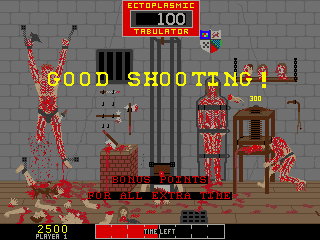 |
| CHILLER OF THE ARCADE - DUNGEON VIOLENCE GAMEPLAY |
Players earn points through finding creative ways to murder these helpless victims as quick as possible. Every action you take mutilates the victims in a clearly graphic and needless way. As discussed in previous posts, culture isn't kind to games that mindlessly use violence for progression and entertainment - Chiller of the Arcade does, much like Carmageddon and Manhunt 1 'and' 2.
For the time, Chiller of the Arcade had realistic graphics, it made use of its pixels completely allowing the game to represent violence and proportion as realistically as Carmageddon, only on a 2D. The issue, at this time, was that games were not rated 18, this would only come into play in the fifth generation. Because of this, many kids had a copy of this game and in result, controversy spared, with a quote stating "this games promotes he murder of innocent people, not enemies that can defend them self . And in that sense I agree, just as I do with the other mindlessly violent games I have researched.
To me, along with Andrews research on games like Manhunt and Grand Theft Auto, this solidifies our conclusion, and will form the basis of the timeline and presentation. Along with the angle I have highlighted, Andrew has also revealed some interesting aspects of violence in games. Aspects such as "Can violence be used to evoke emotions and drive story?" or "Do games influence gamers to commit crime?". With all of these angles, I personally believe both I and Andrew have conducted a thorough and conclusive research portfolio covering violence in games - we explored every angle we though necessary.
NEXT POST: ISSUES WITH WORK UPLOADING
VIOLENCE IN GAMES: SOLDIER OF FORTUNE (2000)
In the majority of the research I have carried out, violence in games was always existent because of three things, entertainment, culture, and conflict. As I move into modern times with modern digital games and violence, there has been a clear shift in how and why this violence is used along with how it is consumed and perceived - the clear culprit is evolution of culture. Carmageddon showed this with mindless violence for the sake of violence, and Manhunt (as seen in Andrew's blog) seemed to take weird pride in disturbing murders that the players committed - both of which caused serious controversies. This next game, Soldier of Fortune, didn't cause a controversy, but caused many heads to turn at the level of violence you could commit.
 |
| SOLDIER OF FORTUNE (2000) - CONTEXT SENSITIVE VIOLENCE |
Soldier of Fortune, originally released in 2000 on PC, is a first person shooter that pushes mutilation and context sensitive damage as a USP using the "GHOUL Damage Model engine developed by Raven Software" that "enabled the depiction of extreme graphic violence" - the developers and publishers of Soldier of Fortune 1 and 2. Although praised for it's character and entertaining game play and damage mechanics, in 2000 after it's release, the controversy began - Soldier of Fortune was rated specifically an "Adult Motion Picture", in other words, it was labelled as "Pornography".
It sounds crazy, but the level of detail the engine facilitated was unheard of before this release. Players could take a knife, and literally cut away into the corpses, revealing more and more organs. This completely optionally mechanic served no real purpose, arming players with a knife for the sole purpose of causing bodily mutilation This extreme take on violence, although entertaining on the most part, was clearly controversial, but it's important to note that it is completely optional. Players could turn the violence off, revealing the solid first person game play experience that it was praised for.
In a sense, Soldier of Fortune is a coin of two sides. One one side, you have a violent game that really has no need for it, where as on the other side, you have a great first person shooter with a solid story, that has no violence or at least optional. So it seems violence isn't 'always' a terrible thing, but became of this games positives, it highlights the issues of violence in video games with a a bright light - mindless violence is what causes the controversy, not violence itself. Maybe it gives off a bad message? That's not to say it makes people commit murder.
Personally, I played the game and loved it when it was released, but I was shocked by the violence and have never looked at games the same way again. In fact, when I first played it, I was disturbed when I first shot an enemy with a shotgun and saw the limbs detach, revealing bones and organs. Yes, it gave the game it's character, and yes, I will always remember it for the violence, but I don't believe the violence was used in a despicable manner like Carmageddon or Manhunt did. It's all about how you use it in a stern modern society. Again, it is society that is the factor, after all, it is just a game, one of which was rated for adults, not children - parents chose to buy it for them.
This game isn't the most well known violent game in the short history of video games, but to me, it's been the most important as of yet, as it's positives highlight the negatives and causes for controversy for not just this game, but for all the previous games I have researched. I guess this is the research almost done when you consider the work Andrew has done. We have highlighted a pattern, researched the deeper factors behind it, and pinpointed the causes. Now all that is left, is to solidify these conclusions and complete the timeline and presentation to exhibit our findings.
NEXT POST: VIOLENCE IN GAMES: CHILLER OF THE ARCADE (1986)
It sounds crazy, but the level of detail the engine facilitated was unheard of before this release. Players could take a knife, and literally cut away into the corpses, revealing more and more organs. This completely optionally mechanic served no real purpose, arming players with a knife for the sole purpose of causing bodily mutilation This extreme take on violence, although entertaining on the most part, was clearly controversial, but it's important to note that it is completely optional. Players could turn the violence off, revealing the solid first person game play experience that it was praised for.
In a sense, Soldier of Fortune is a coin of two sides. One one side, you have a violent game that really has no need for it, where as on the other side, you have a great first person shooter with a solid story, that has no violence or at least optional. So it seems violence isn't 'always' a terrible thing, but became of this games positives, it highlights the issues of violence in video games with a a bright light - mindless violence is what causes the controversy, not violence itself. Maybe it gives off a bad message? That's not to say it makes people commit murder.
Personally, I played the game and loved it when it was released, but I was shocked by the violence and have never looked at games the same way again. In fact, when I first played it, I was disturbed when I first shot an enemy with a shotgun and saw the limbs detach, revealing bones and organs. Yes, it gave the game it's character, and yes, I will always remember it for the violence, but I don't believe the violence was used in a despicable manner like Carmageddon or Manhunt did. It's all about how you use it in a stern modern society. Again, it is society that is the factor, after all, it is just a game, one of which was rated for adults, not children - parents chose to buy it for them.
This game isn't the most well known violent game in the short history of video games, but to me, it's been the most important as of yet, as it's positives highlight the negatives and causes for controversy for not just this game, but for all the previous games I have researched. I guess this is the research almost done when you consider the work Andrew has done. We have highlighted a pattern, researched the deeper factors behind it, and pinpointed the causes. Now all that is left, is to solidify these conclusions and complete the timeline and presentation to exhibit our findings.
NEXT POST: VIOLENCE IN GAMES: CHILLER OF THE ARCADE (1986)
VIOLENCE IN GAMES: CARMAGEDDON (1997)
When the fifth generation of gaming consoles hit the market, the 1994 console release Playstation 1 promised better graphics, better game play and far greater immersion. In most cases, the Playstation proved successful, but it was soon apparent that this creative freedom could be utilized for something different that had never been done before - realistic violence.
I personally remember opening up a gaming magazine to read in depth about SCI's new IP, Carmageddon - what Mail Online calls;
It seemed fun and fresh, but at such a young age, it actually disturbed me, because Camageddon's concept and game play revolved entirely around one thing - murder by reckless driving. Instantly this gives off all kinds of wrong messages to children, and considering it was my first look at violence in anything, It's safe to say it had a negative impact on me.
Here's the premise - players race against other opponents whilst battling against a timer. The only way to beat the timer, is to run over pedestrians violently to earn time bonuses. The ability to commit such mindless violent acts is no surprise when you consider the Vikings and various other cultures did the exact same thing ages ago, but regardless, controversy stuck hard considering the new platform and potentially exposed audience.
In a culture where murder is illegal, the death penalty is banished and pretty much any negative action is looked down upon, Armageddon was an in your face reminder that this type of violence isn't welcome anymore (unlike in the Roman rule). Along with this dismissal and controversy over this extremely graphic virtual violence, the platform posed issues also - children could join in on the violence (virtual violence of course). But considering I was effected greatly by it (I cried), it's easy to see how such easy exposure to violence is controversial, raising many questions as to where and what games should be and go. In fact, this game was so violent for the time, it was the first game to be refused an ERSB rating - it was too violent.
Carmageddon was one of the first real controversies in gaming, as this experience was a more immersive than it's arcade counterparts such as Death Race (similar concept), as they were just concepts backed by 8-bit graphics, Carmageddon was a concept executed through fully 3D models of violence - violence which dominated the entire screen and game. It was seen as 'entertainment' to commit such blind acts of virtual violence. It not only spread the message that violence was entertaining and rewarding, but it glorified it and promoted reckless driving to potential innocent children. The latter point is the key point in this controversy, and still is today.
SCI eventually re-cut the game, replacing "pedestrians with zombies" to justify the violence, but in an open statement, SCI admitted that "the violence and controversy was deliberately courted" - this says it all really.
Now, there are many sides to this argument that exist even today. But Camrageddon was admittedly one of those games that went to far too soon. What I find interesting about this game however, is it's sheer contrast (and similarities) to the previous research I have carried out. Carmageddon was a game that used violence for no other reason than to have violence. And when children could be exposed to such things and a culture that is radically different that for example, the Roman Empire, you have a game that allowed people to commit acts of violence with no punishment, only reward. This is the difference between then and now. Back in ancient times, violence may have been more common in society as a whole, but when used for entertainment, it was mostly controlled, usually backed by cultural praxis or military conflict. Here, it's mindless and dangerous.
From this point, if you take a look at Andrew's blog, you will see that this pattern in a revised modern society continue to make itself known, bringing along many controversial stories along with it. Games such as Manhunt and Grand Theft Auto stimulate the same arguments from different angles, and I think this is entirely down to the platform, modern society, and the use of violence in this accessible media.
It's surprising to say, that even with this controversy that still makes itself known today, Camrageddon is actually being remade as a result of a die hard community kickstarter, again, spawning further controversy. Carmageddon was a lesson to all developers when it came to violence in games, but violence in games has never held back, the way it is used however, has changed.
NEXT POST: VIOLENCE IN GAMES: SOLIDER OF FORTUNE (2000)
 |
| CARMAGEDDON - VIOLENT GAMEPLAY |
I personally remember opening up a gaming magazine to read in depth about SCI's new IP, Carmageddon - what Mail Online calls;
"The most controversial game of all time".
Here's the premise - players race against other opponents whilst battling against a timer. The only way to beat the timer, is to run over pedestrians violently to earn time bonuses. The ability to commit such mindless violent acts is no surprise when you consider the Vikings and various other cultures did the exact same thing ages ago, but regardless, controversy stuck hard considering the new platform and potentially exposed audience.
In a culture where murder is illegal, the death penalty is banished and pretty much any negative action is looked down upon, Armageddon was an in your face reminder that this type of violence isn't welcome anymore (unlike in the Roman rule). Along with this dismissal and controversy over this extremely graphic virtual violence, the platform posed issues also - children could join in on the violence (virtual violence of course). But considering I was effected greatly by it (I cried), it's easy to see how such easy exposure to violence is controversial, raising many questions as to where and what games should be and go. In fact, this game was so violent for the time, it was the first game to be refused an ERSB rating - it was too violent.
Carmageddon was one of the first real controversies in gaming, as this experience was a more immersive than it's arcade counterparts such as Death Race (similar concept), as they were just concepts backed by 8-bit graphics, Carmageddon was a concept executed through fully 3D models of violence - violence which dominated the entire screen and game. It was seen as 'entertainment' to commit such blind acts of virtual violence. It not only spread the message that violence was entertaining and rewarding, but it glorified it and promoted reckless driving to potential innocent children. The latter point is the key point in this controversy, and still is today.
SCI eventually re-cut the game, replacing "pedestrians with zombies" to justify the violence, but in an open statement, SCI admitted that "the violence and controversy was deliberately courted" - this says it all really.
Now, there are many sides to this argument that exist even today. But Camrageddon was admittedly one of those games that went to far too soon. What I find interesting about this game however, is it's sheer contrast (and similarities) to the previous research I have carried out. Carmageddon was a game that used violence for no other reason than to have violence. And when children could be exposed to such things and a culture that is radically different that for example, the Roman Empire, you have a game that allowed people to commit acts of violence with no punishment, only reward. This is the difference between then and now. Back in ancient times, violence may have been more common in society as a whole, but when used for entertainment, it was mostly controlled, usually backed by cultural praxis or military conflict. Here, it's mindless and dangerous.
From this point, if you take a look at Andrew's blog, you will see that this pattern in a revised modern society continue to make itself known, bringing along many controversial stories along with it. Games such as Manhunt and Grand Theft Auto stimulate the same arguments from different angles, and I think this is entirely down to the platform, modern society, and the use of violence in this accessible media.
It's surprising to say, that even with this controversy that still makes itself known today, Camrageddon is actually being remade as a result of a die hard community kickstarter, again, spawning further controversy. Carmageddon was a lesson to all developers when it came to violence in games, but violence in games has never held back, the way it is used however, has changed.
NEXT POST: VIOLENCE IN GAMES: SOLIDER OF FORTUNE (2000)
Saturday, 13 April 2013
VIOLENCE IN GAMES: IGN VIOLENCE ARTICLES
Even when not researching for this project, I'm coming across really notable and interesting articles and videos on modern video game violence. Articles that discuss contemplate and highlight conclusions on violence in games - articles that can only benefit my research.
Most recently, IGN posted two articles discussing violence in games, which is a statement in itself about how controversial and popular the topic in question is. Both focus on Senator Feinstein's views, but it draws a nice contrast between the leaders and official's views of violence in ancient times to now, pointing at culture and morality being the primary cause of our different views of violence in games and culture.
Senator Feinstein has never been known to appreciate violence in games, or any form of violence or crime in fact, she shows some real dedication to the concerns of such a topic with it;s relation to crime, or gun crime more importantly, so her opinions are really valid in this research task.
In the first article discusses her opinion that there is a clear connection between violence in games to violence in reality (found in the article link below).
She states, “I think the really violent video game becomes a kind of simulator to practice on,” she said. “It enables the individual to become much more familiar with that depiction of death and blood. Of course it's not the way it is in real life.”. It's a completely valid point, some games like Flashpoint can really offer such realistic 'training;' combat simulator experiences, but as she says, it doesn't make them an expert. However, what this doesn't prove however, is that violence in games can directly influence a player's decision to actually take action and commit murder or violence against innocent people. That is surely all down to psychology and the psychology of that individual which can lead to many topics such as childhood upbringing social encounters and experiences and much more. Which is fitting, because she then goes on to say that games have a "very negative influence on children". I understand this point, 20 years ago, games were unrealistic representation of conflict and violence, now, games are so realistic they could be considered life simulators - simulators that offer clear violence as a rewarding alternative. Whether or not this is the intention of game developers is not definite. Maybe violence in games is just a form of entertainment as it always has been, and it's modern society and it's pressures that has spawned such recent horrible and controversial crimes. Either way, it is something developers should take into account.
I shall research more into this when looking at violence in modern games, both controversial and common games.
The second article again, covers Feinstein's views on violence in games. This time, in relation to the recent shootings in America.
NEXT POST: VIOLENCE IN VIDEO GAMES: VIDEO GAMES TO RESEARCH
Most recently, IGN posted two articles discussing violence in games, which is a statement in itself about how controversial and popular the topic in question is. Both focus on Senator Feinstein's views, but it draws a nice contrast between the leaders and official's views of violence in ancient times to now, pointing at culture and morality being the primary cause of our different views of violence in games and culture.
 |
| SENATOR FEINSTEIN ON GUN CRIME |
Senator Feinstein has never been known to appreciate violence in games, or any form of violence or crime in fact, she shows some real dedication to the concerns of such a topic with it;s relation to crime, or gun crime more importantly, so her opinions are really valid in this research task.
In the first article discusses her opinion that there is a clear connection between violence in games to violence in reality (found in the article link below).
I shall research more into this when looking at violence in modern games, both controversial and common games.
The second article again, covers Feinstein's views on violence in games. This time, in relation to the recent shootings in America.
She believes that games have “a very negative role for young people, and the industry ought to take note of that.” She went on to say, "If Sandy Hook doesn't do it, if the knowledge of these video games this young man played doesn't, then maybe we have to proceed, but that is in the future.”
This comment is supposedly supported by the vague link that Sandy Hook was an avid gamer. It could be circumstantial, or it may be the sole cause. I guess this is a discussion that is still yet to conclude - I can only give my 'opinion' based on the research I can find. I for one, do not believe this is entirely the case, as discussed in the last post. But one thing that is for certain, is that in today's culture with today's tragic events, developers need to evaluate how violence is used in gaming - not that all developers use it wrongly.
I think the validity of such comments can only be established once I look at further studies on violence and violence in games. In fact, I recently found a little biological study that could facilitate some of these comments whilst also dismissing them. Violent game's don't 'create' murders, they stimulate them and 'could reinforce there decisions.
NEXT POST: VIOLENCE IN VIDEO GAMES: VIDEO GAMES TO RESEARCH
Tuesday, 26 February 2013
VIOLENCE IN GAMES: BONUS ROUND DEBATE
Gametrailers.com's most recent episode of Bonus Round focused on the controversial topic revolving around violence in video games, and the social stigma attached to them when compared to the recent spike in gun crime and violence. It's a controversial social debate that has been around for many years, with many studies to support both sides. A have a strong opinion myself, but the reason I mention this link relates to my recent assignment - to thoroughly research and document that lifespan of violence in 'Games' through a visually rich timeline.
To me, this video is incredibly insightful (along with others) when considering the ramifications and reasoning's for violence in games as a whole. An important goal for me, is to not just research and document the way violence in games has changed, but to also recognised the pattern persistent throughout its lifespan (if there is one). Through doing this, I could develop an concise understanding of violence in games, from the real bloodshed in gladiator battles thousands of years ago, to the artificial bloodshed in video games today.
NEXT POST: COMING SOON!
To me, this video is incredibly insightful (along with others) when considering the ramifications and reasoning's for violence in games as a whole. An important goal for me, is to not just research and document the way violence in games has changed, but to also recognised the pattern persistent throughout its lifespan (if there is one). Through doing this, I could develop an concise understanding of violence in games, from the real bloodshed in gladiator battles thousands of years ago, to the artificial bloodshed in video games today.
NEXT POST: COMING SOON!
Sunday, 6 January 2013
ART DECO ESSAY (FINAL DRAFT)
It’s a visually
rich palette. It’s a modern statement. It’s mathematical and elegant. It’s an
elitist movement, ripe with cultural influence. It’s Art Deco. Since it originated
in 1900, Art Deco has shrouded the world with a culturally and technologically
influenced art style. It became a symbol - It became an era. Manifesting from a
sudden surge of technological progression, Art Deco embraced a generation
through a plethora of art forms in “design
and the decorative arts” (Carolyn
Mcdowall, www.youtube.com, What is Art Deco, 2010) –
architecture, interior design, furniture, decoration and even transport. With a
huge thanks to an ensemble of key influential organisations, exhibitions and
most importantly, designers - such as Hector Guimard, Eugene Grasset and Raoul Lachenal
- Art Deco was not just propelled into the elite society for a temporary phase,
it became an artistic revolution – a cultural icon of the 20th
century. Modern society recognises it, identifies with it and even to this day,
exhibits its influence unknowingly. However, its journey was not short or
straight – it rose, fell, reached its apex and eventually stamped its mark on
arts history, on society’s history. And through recent years of disinterest and
neglect, its rhythm has started to pulsate yet again - Art Deco “is enjoying a substantial revival of
interest” (Eva Weber, E. W. (2003) Art Deco. JG Press.)
THE HISTORY AND
JOURNEY OF ART DECO
Holding an
exaggerated “mirror” (Eva Weber, E. W. (2003) Art Deco. JG Press) to its
times, Art Deco represented the cultural progression Paris witnessed in the
late 19th and early 20th century. Technology had begun
its worldwide journey through surges of interest and a loop of technological
evolution. However, it didn’t
just “become”, it was an influenced
manifestation and departure from other movements - Art Nouveau, Modernism and Cubism.
Carolyn Mcdowall believes “It borrowed
from virtually all the design stars of the past in order to fashion the future”
(www.youtube.com, What is Art Deco, 2010). In
other words, it was a retrospective study of the past that gave its response
with modern influence in order to lead the way - and it did. Its aims focused on “simplifying form,
streamlining it, and fitting it to suit function” (www.youtube.com, 2010) as Carolyn Mcdowall believes. Take
the two examples to the right – the 1930’s decorative, geometrical staircase
with iron bars and oak wreathed handrails, as well as the 21st
century clinical, mathematical and elegant staircase – you can see this design
philosophy flowing within these two interior staircases. They are simple, they
are streamlined - they are functional. But declared quondam, Art Deco resonated
within a cluster of art forms within the decorative arts. Such examples are the
colourfully bold stained glass window salvaged from old “residential homes from England” (www.stainedinglass.co.uk, 2004) or the iconic 1933 Chicago World's Fair poster, that
summarised Art Deco on all parts and even the glorifying female “Flapper”
fashion that revolutionised the independence of woman. This variety of examples
grounds Art Deco’s embrace as a fact of life, not just an artistic theory – it
defined a generation.
Years passed,
Art Deco hit its stride, its influence was felt and its apex finally arrived.
Its penultimate stop - central between two world wars - and thus, its eventual
wane in popularity. Why? The Great Depression. The war was less a physical,
more an economic disaster, especially in France, with ArtHistory.net stating
that “it did have to rebuild its economy
after the Great Depression of 1929” (www.arthistory.net, 2009). Money was scarce, resultant from the financial redirection
for arms and military defence. The result? Industrialisation – everything was at the bare
minimum, with no room for extravagant, elitist, biased design. Art Deco began
to lose its cultural popularity, leaving in its wake a permanent shadow of its
former self – cars, transport and architecture. Its most famous
examples being the UK’s Midlands Hotel in Morecombe and the Parade of
Progress transit van – projections of Art Deco’s artistic style (both seen above).
Art
Deco’s influential journey, from its rise to its fall, wouldn’t have been
possible but for those who drove it, developed it and solidified it – its key
Designers, Hector Guimard, Eugene Grasset and Raoul Lachenal, or to abbreviate
it, the Decorative Artists Society
ART DECO’S KEY
DESIGNERS
What is
the Decorative Artists Society? What did it do for Art Deco? Who were those
involved? What was their influence on the movement? These are the questions
that must be answered to appreciate Art Deco’s journey from an influenced idea
to a movement that influenced the future.
ArtHistory.net declares that the
“founder of the Decorative Artists Society” was “Hector Guimard” (www.arthistory.net, 2009) along
with other key influential designers. With the goal to demonstrate
internationally, the evolution of French decorative arts, the Decorative Arts
Society followed Art Nouveau and moulded Art Deco as an extension of its ornate
heritage – a influenced predecessor – a homage with its own statement.
Practicing with this goal and influence at its core, three early members used
the Decorative Arts Society as a catalyst for creative expression - Hector
Guimard, Eugene Grasset and Raoul Lachenal. However, their intrinsic talent
existed long before this milestone in Art Deco’s journey – they were each individual,
passionate, artistically craving and independent designers with their own
influences and rich portfolios.
Starting
with the most renowned founder of the Decorative Artists Society, Hector
Guimard, born in 1867, “was an important
French architect, interior designer and designer of Art nouveau objects.” (www.hector-guimard.com,
2007) Influenced heavily by the Belgian designer and architect Victor
Horta, Guimard’s most famous work was Paris’ Art Nouveau metro entrances, with
their artistic legacy surviving to this present day – 86 of them to be exact.
Completing main bodies of personal work, Guimard took it upon himself to accept
various commissions for projects, eventually becoming the pin-up for Art
Nouveau - and rightfully so, with HectorGuimard.com stating he was “regarded as the leading exponent of the Art
nouveau style, which is often called the "Style Guimard" in France.”
(www.hector-guimard.com, 2007). This
was a feat by all means; he became an icon and astoundingly, an influence to
his influences. His artistic legacy was an eventuality of passion and attention
to detail. “No detail was unimportant to
him” (www.hector-guimard.com, 2007) – his
work with iron, steel and colour in architecture left an influential ripple
that confidently placed the foundation of Art Deco. But he was not alone.
Eugene Grasset
was a man of many artistic trades – “carpet patterns, decorative iron,
jewellery, calendars, postage stamps, and much more.” (www.eugene-grasset.com, 2007). Born May 25th,
1841, in a French speaking Switzerland city named “Lausanne”, Grasset started his
journey studying architecture at a school in Zurich. Although not a conclusive
success, he travelled the world, ravishing and soaking up the variety of
cultures surrounding him. Egyptian, Aztec and Parisian are just a few to name
and through it, eventually came home from his sophisticated venture, “active in all areas of applied art,
including furniture design, book illustrations, and posters.” (www.eugene-grasset.com, 2007). His famous
versatile portfolio of work included the façade of the Hôtel de Dumas in Paris, mosaics in Saint Etienne in Braire and
stained glass windows in the cathedral at Orléans. Although not the cultural
icon Guimard was, the “versatility and
the trends in his works” were solely responsible for his comparisons to
reformers such as Walter Crane. In that fact, he became an invaluable tool to
the Decorative Artists Society - a bible of cultural knowledge, leaving only
one more designer to complete the comprehensive trio - Raoul Lachenal.
Working “in his father's studio until 1911, when he
established a new workshop at Boulogne-sur-Seine.” (www.jasonjacques.com, 2011), Raoul Lachenal
focused on the art of ceramics. With a heavy exertion of influence from his
father, Edmond Lachenal, organically formed influences beamed through his
glazed ceramic work. However, his work still retained a personal character - a
personal expression. After developing his accomplished portfolio, he finally
exhibited his extravagant stoneware at the Paris salons in 1904. With a “positive
reception” to such work as the Lotus Charger and Curvy Vines, he took that as a successful milestone
and began to develop upon it. He “adopted
an additional decorative mode: incising geometrical designs on stoneware and
filling the sections with vividly contrasting slips.” - Key design aspects
that eventually defined the movement, Art Deco. Whilst he was not a great
versatile, influential pioneer like Grasset or Guimard, Lachenal had developed
a precise talent for decoration, and brought his geometric character to the
Decorative Arts Society.
As a
collective, all three designers brought their palette of varied knowledge and
experience to the table to develop a unification of styles, influences and
ideas. The result? An artistic society which demonstrated the evolution of
French decorative arts. However, although each designer brought their talent to
push Art Deco to its apex between the wars, The Great War brought along with it
an industrialised world to facilitate The Great Depression – a point in history
that tortured the wealthy art style of Art Deco. Along with the biased, elitist
movement, the wealthy shapes and the vibrant colours, Art Deco and its
facilitator, the Decorative Arts Society, waned. Regardless, by this point, Art
Deco had already left its stamp of cultural and artistic history – it had an
image, an atmosphere, even a way of life.
However, years
passed before Art Deco reached its apex. It was only until the “Exposition Universelle” of 1900 that
promoted Paris’s achievements of the past century that Art Deco “really” started to naturally manifest
as its own independent movement. It was at this retrospective that the “Decorative Artists
Society was founded following the Universal Exposition of 1900”
(www.arthistory.net, 2005). This was to become the
most crucial step of Art Deco’s journey as its early members were influential designers
- Hector Guimard, Eugene Grasset and Raoul Lachenal. Coincidentally,
these designers just happened to practice Art Deco’s main influences – Art Nouveau,
Cubism and Modernism. These are the individuals that eventually set the
foundations, built upon the foundations and set the standard Art Deco is
internationally identified by today. Not years later, in 1925, did the “Exposition Internationale des Arts
Decoratifs et Industriels Modernes” take place, where John M.
Cunningham states “the style
was first exhibited” (www.britannica.com, 2012). Before this, it was a developing style, attempting to find
its feet and keep its footing as the style “Style
Modern” (www.britannica.com, 2012). It was at this famed
exhibition, that the term “Art Deco” was
coined – which, as surprising as it is, was an abbreviation of the
exhibitions name which propelled it into the cultural spotlight.
THE CULTURAL
IDENTITY OF ART DECO
“Hollywood is Art Deco, Art Deco is Hollywood” (www.youtube.com, 2011) – a single quote from Dr Susan
Currell, an expert in American Studies, which summarises Art Deco as a whole.
It’s “all about glamour”, historian
Carolyn Mcdowall confidently states. The fact is, the general public didn’t see
Art Deco’s influences in homes, rather, they were exposed to it through
television and cinema. In fact, Hollywood owes its success to Art Deco, as does
Art Deco owe part of its international success to Hollywood. France had heard
of its name and seen its design, but it was only after this overexposure to the
glamorous new-age statement that it started to flood culture with its artistic
integrity – its idolised image. British designers such as Clarice Cliff
introduced Art Deco to the mass market in the 1920, but it was Hollywood’s Art
Director Frederick Gibbons that marketed the movement consciously to give
Hollywood the glamorous, modern stereotype the 1920’s to 1940’s film industry has
today. It “Represents novelty” and was
“what people looked for” for in
entertainment. Films like “Sabrina” (1954)
had Art Deco influences - the buildings, the fashions, the female independence,
the interior design and the extravagant furniture. “Our Dancing Daughters”
(1928), a classic noire film, clearly showed the fashionable “Flapper” style women were often
pictured in – it was independence, beauty and glamour. However, it was not the
sum of its parts that conjured Art Deco’s representation to the public, it was
the parts themselves.
“The characteristic features of these
pavilions included zigzag architectural setbacks, the use of unusual materials,
the incorporation of decorative wall paintings and ornate metal and glass
worked in geometric and floral patterns. Exquisite metal work by Edgar Brandt
and decorative glass by Lalique were to be found.” (Eva
Weber, E. W. (2003) Art Deco. JG Press.)
By observing
architecture such as the Chrysler Building, The Golden Gate Bridge and the
Morecombe Hotel, you can see how the quote retains validity. Famous for
its mathematical and elegant geometric shapes, Art Deco
became heavily influenced over the early 20th century. In the UK you
have the Midlands Hotel in Morecombe, inspired by the geometrical focus Art
Deco adopts. In the US you have the Chrylser Building which
was inspired by the trademark Sunburst Motif, and the
Golden Gate Bridge which focuses on mathematical shapes
to facilitate function. Art Deco’s identity even finds itself within the
interiors of cinema theatres - cinemas such as the Royal Palace Theatre.
It was this
consolidation of attributes that composed the general cultural image Hollywood
utilised and in turn, the image the world adopted. However, these parts
originated from the designers that implemented them into the mix – designers who
were influenced both individually and as a collective society.
THE INSPIRATIONS
OF ART DECO
The Art
of Babylon. Ancient Egypt. Aztec Mexico. Africa. A culmination of historical styles
that spawned the common household image of Art Deco and, without realising it,
modern society is exposed to its massive influence day by day. Now, look back
at the quote from Carolyn Mcdowall - “It borrowed from virtually all the
design stars of the past in order to fashion the future” (www.youtube.com, 2010). Now look at the aforementioned cultures
– these are the design stars so vaguely mentioned in Mcdowall’s commentary and
with them, Art Deco created a collage of these artistic inspirations to create
a whole new vision of the present, and an ambition of the future. But there was
one design style which prompted its cloud nine ambition - Art Nouveau, its
forerunner movement.
Many find it hard to differentiate
between these two. Simply because Art Deco is the spiritual younger brother of
Art Nouveau and in turn, share many similar ideologies and visual qualities. So
what is Art Nouveau? It’s “Fluidness, curvy,
intricate, decorative, flowery.” (www.youtube.com, 2011) says Spencer Thompson. There were a
lot of natural elements incorporated into Art Nouveau pieces – it was a
decorative statement - a protest against the mass producing, industrial
revolution. In this movement ‘decorative’ is the operative adjective. Art Deco
had similar aims and visual aspects – decoration through elegance, shapes and
imagery. However, the difference here is that Art Nouveau was a reaction. Art
Deco was an observation and glorification, borrowing mainly from its design
hero Art Nouveau, twisting it with its own character for a literal but
exaggerated representation of modern society. But there was one more design
style culprit that created the shadow that Art Deco could light – Avant Garde.
Vam.co.uk states that Avant Garde was “The new visual language, colour and iconography” (www.vam.co.uk, 2003). Its geometric
abstract and visually fragmented vocabulary placed the foundation for Art Deco
to colour. As a design style that was also a combination of forerunner styles,
Avant Garde was a statement of dynamic modernism. It was this statement and
this ideology alone that inspired the young Art Deco. Think of Avant Garde as
the dotted lines that Art Deco could connect, followed by colouring in between
those influenced lines with Nouveau’s colourful, decorative palette – the
result is Art Deco, a movement which took from the past, to create the new.
So, Art Deco
was a natural evolution of various styles and cultures. It progressed with a
little artistic and social assistance to define a generation. It then witnessed
another milestone – The Great Depression - forcing Art Deco into hiding. But in
this wane, it left Art Nouveau’s and Avant Garde’s influential shadows to stand
its own spotlight. It placed the stamp at the end of its story, leaving behind
its legacy - a legacy that influenced others. Now, in the present day, Art Deco
has come full circle. It “is enjoying a
substantial revival of interest” (Eva Weber,
E. W. (2003) Art Deco. JG Press.)
ART DECO
TODAY
Mass production in the mid-20th
century forced Art Deco into the industrial revolution’s aftermath, to be left
in the dark with only threads of light to highlight its parts. Now, in the 21st
century, its legacy remains as a whole, but its book seemingly remains closed,
waiting for a new chapter. These threads of light remain within the various
examples of lasting architecture, fashion and furniture. However, there are
still enthusiasts out there that believe Art Deco’s heritage and legacy are as
important now, as they were in the early 20th century. Art
Deco Society of Boston is one of such governments. The society’s goal “is the preservation of our Art Deco and
Modern architectural heritage.” (www.bostonartdeco.com, 2009). And with Art
Deco’s remnants aging every day, the society aims to preserve key locations and
works that symbolise its legacy. But even within this desperate grasp on Art
Deco’s legacy, it still makes itself known around the world. The Midlands Hotel
and the Chrysler Building are examples already discussed, but Art Deco hides
within the cracks today’s influences forget to polish over with its ignorance.
It was said that Art Deco featured heavily in theatres, this has not changed.
The Cineworld Cinema is the most popular cinema in the UK. The photo to the
right, taken in Didsbury, is one of the many identical screens around the in
the UK. Look closely and instantly seen,
is the sunburst motif created by the
use of light and shadow - in this case it is actually used to present
light rather than to represent an ideology or symbol like
the Chrysler Building succeeded in doing, with its sunburst peak as
if to say "Look at this, look at
what our country has accomplished". This Cineworld in
Didsbury, like many others around the country, simply used it for
effect - understandable considering its magnificent effect.
CONCLUSION
Art Deco
started as a conceptual vision, inspired by what came before it, adopting
various aspects of various ideologies, directions and historical designs. It
took its journey, blossoming with a little help from exhibitions, influential
designers, ambitious societies and pop culture. In the end, it reached its apex
during the wars, lost its relevant energy, and waned through time and events.
However, in its partial demise, remained legacy – a legacy that influenced the
future, leaving a lasting impression to artistically cherish. Replacing, were
new interpretations of modern society and new visions of the future - movements
such as Futurism and Memphis, which were more relatable. However, without Art Nouveau, Avant Garde, Cubism
and Modernism, today’s predecessor movements wouldn’t exist, nailing Art Deco’s
legacy to our history. Satisfying and approving its goal – to borrow “from virtually all the design stars of the past in order to fashion the
future” (www.youtube.com, What is Art Deco?, 2010). This
remained core to the movement Art Deco, proving that although flawed in its bias
towards the elite, Art Deco was a milestone in the arts.
NEXT POST: VIOLENCE IN VIDEO GAMES: BONUS ROUND DEBATE
RAOUL LACHENAL (KEY DESIGNER)
Again, like Grassett, Raoul Lachenal was no pioneer in any of his artistic crafts, however, his influences and talent in decoration ended up becoming an iconic staple of the Art Deco Movement. The research I carried out on him follows;
That concludes the majority of the research for the Art Deco essay that I carried out. From this research, I could develop an essay that discussed its history, its designers, its journey, its influences, its identity and finally, its modern existence. All that remained was to cut this first draft down and polish it up.
NEXT POST: ART DECO ESSAY (FINAL DRAFT)
 |
| CURVY LINES - LOTUS CHARGER |
 |
| RAOUL LACHENAL - LOTUS CHARGER |
- Born in 1885
- Worked in his father's studio until 1911.
- Established a new workshop at Boulogne-sur-Seine.
- Focused on the art of ceramics - organically formed influences.
- Exhibited his extravagant stoneware at the Paris salons in 1904.
- He Adopted geometrical designs on stoneware and filling sections with contrasting slips.
- Developed a precise talent for decoration.
- Helped found the Decorative Arts Society.
That concludes the majority of the research for the Art Deco essay that I carried out. From this research, I could develop an essay that discussed its history, its designers, its journey, its influences, its identity and finally, its modern existence. All that remained was to cut this first draft down and polish it up.
NEXT POST: ART DECO ESSAY (FINAL DRAFT)
Subscribe to:
Posts (Atom)